Particle (Basic ㊦ 181)
A sentence final particle which expresses the idea that the female speaker wonders about something.
Equivalent: I wonder
| (i) {V/Adjective い} informal | かしら | |
| {話す /話した} かしら | I wonder someone (will) talk/talked | |
| {高い /高かった} かしら | I wonder something is/was expensive | |
| (ii) {Adjective な stem/ N} | {Ø/だった} かしら | |
| {静か /静かだった} かしら | I wonder something is/was quiet | |
| {先生/ 先生だった} かしら | I wonder someone is/was a teacher |
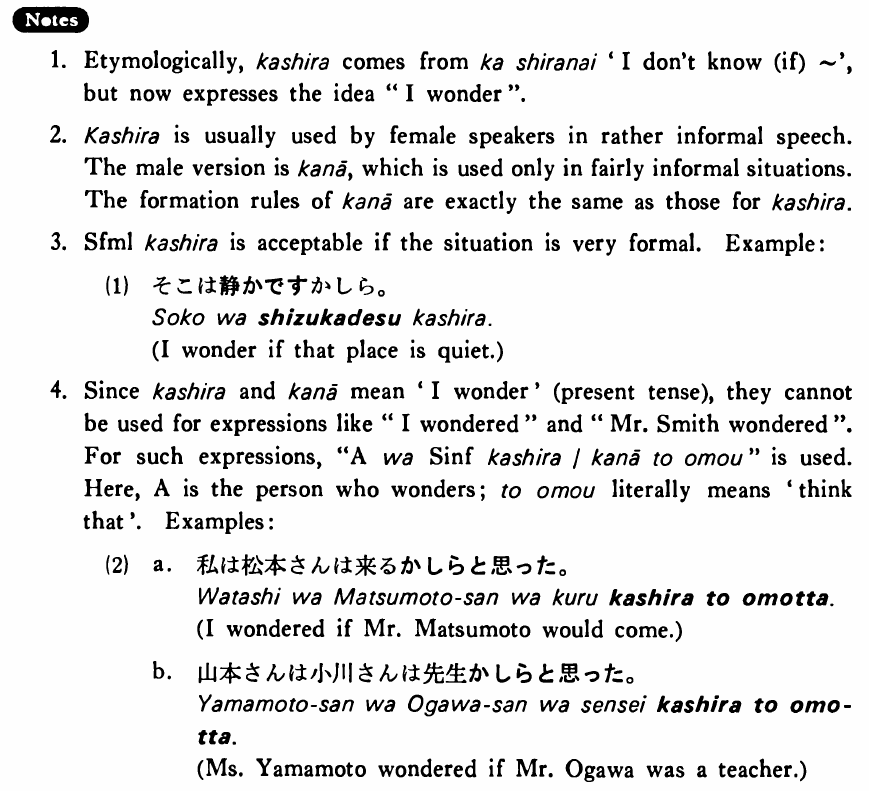
1. Etymologically, かしら comes from か知らない 'I don't know (if) ~', but now expresses the idea "I wonder".
2. かしら is usually used by female speakers in rather informal speech. The male version is かなあ which is used only in fairly informal situations. The formation rules of かなあ are exactly the same as those for かしら.
3. Sentence formal かしら is acceptable if the situation is very formal. Example:
4. Since かしら and かなあ mean 'I wonder' (present tense), they cannot be used for expressions like "I wondered" and "Mr. Smith wondered". For such expressions, "Aは Sentence Informal かしら/かなあと思う" is used. Here, A is the person who wonders; と思う literally means 'think that'. Examples: